
BLOG
Your 2027 Career Goals Checklist: Turn Your Next Move Into a Plan
How do you want to define your 2027 career goals? with precision, assess your skills and spot growth opportunities, build a sustainable job-search action plan, and use a free downloadable checklist to track your progress along the way.
6 min read • November 24, 2026 • By Rea Martin

A new year has a way of making you pause and ask the bigger question: where do I actually want my career to go? That question can feel overwhelming if you let it. But setting clear career goals 2027 doesn't require overhauling your life overnight.
Maybe you're a recent graduate trying to land your first full-time role. Maybe you're shifting industries after realizing your current path isn't the right fit. Or maybe you're already employed and eyeing a promotion within your organization.
This checklist approach works for all three, because it's less about your starting point and more about building momentum toward a defined outcome.
Step 1: Define your 2027 career goals
Vague ambitions like "get a better job" rarely lead anywhere. Without a defined target, it's hard to know what action to take next, and even harder to recognize progress when it happens. Specific, time-bound goals change that. They give you a finish line, a reason to act today instead of someday.
A SMART framework makes this concrete. Your 2027 career goal should be:
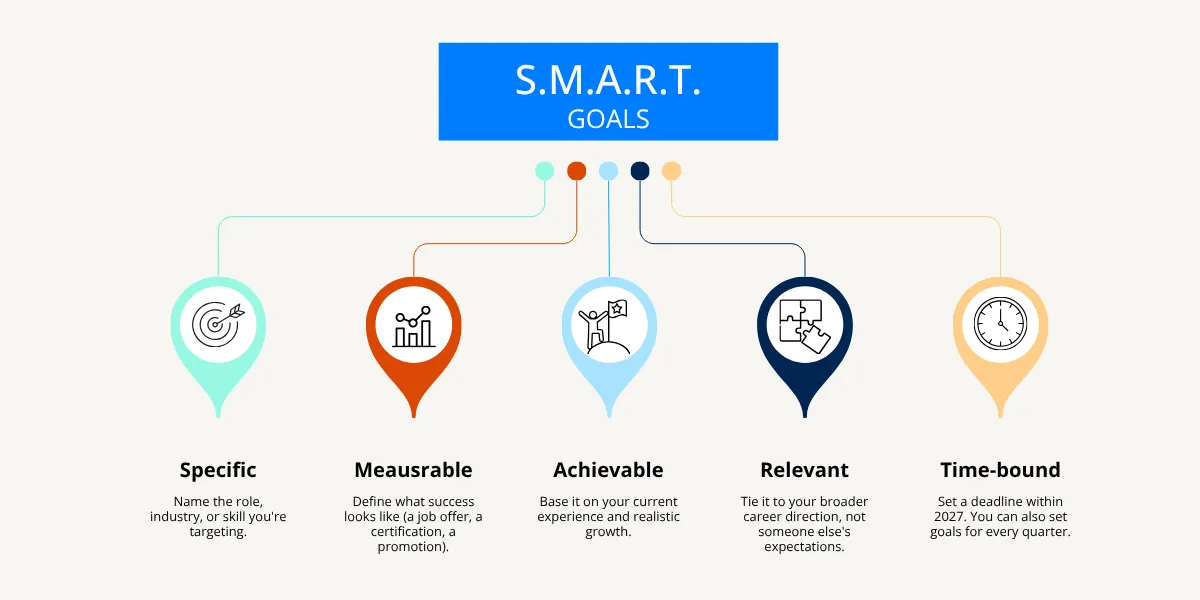
Applied in practice, a vague goal like "work in customer service" becomes: "Secure a customer experience associate role at a global BPO company by Q2 2027, using bilingual skills as a differentiator." That's a goal you can plan around.
A few more examples across different career paths:
- Entry-level job seeker: "Land my first full-time customer support role by June 2027, with at least one completed certification in CRM tools."
- Career shifter: "Transition from retail management into a team lead role in customer experience by the end of 2027, applying transferable leadership skills."
- Internal promotion seeker: "Earn a promotion to senior support specialist by Q4 2027 by completing two internal training programs and taking on a mentorship role."
Once you've landed on your goal, write it down. This isn't a formality. Committing a goal to paper, or to a shared document, turns an intention into something you're accountable to. It's the first real step in career planning for 2027, and it sets up everything that follows.
For more on building a long-term career trajectory, TTEC's blog on career development offers additional strategies worth exploring.
Step 2: Assess your skills and identify growth opportunities
With your goal defined, the next move is an honest skills assessment. Start by listing everything you currently bring to the table: your certifications, your work experience, and both your technical and interpersonal strengths. Then compare that list against the requirements of the roles you're targeting.
This audit should cover two categories:
- Technical or hard skills: CRM platform experience, bilingual or multilingual ability, data entry accuracy, or familiarity with support ticketing systems.
- Soft skills: Empathy, adaptability, clear communication, and the ability to stay composed under pressure. These matter just as much in customer-facing roles, and often set strong candidates apart from the rest.
Once you've mapped your current skills against your target role, you'll likely spot gaps. That's normal, and it's useful information. A skills assessment checklist isn't meant to highlight what you're missing in a discouraging way. It's meant to point you toward exactly where to invest your energy next, whether that's a certification course, a mentorship relationship, or a structured training program.
Lorem ipsum dolor sit ame
Lorem ipsum dolor sit amet, consectetur adipiscing elit, sed do eiusmod tempor incididunt ut labore et dolore magna aliqua. Ut enim ad minim veniam, quis nostrud exercitation
Lorem ipsum dolor
Step 3: Build a realistic job-search action plan
A goal and a skills assessment only get you so far without action behind them. This step turns your 2027 career goals into a weekly practice.
Break your job-search action plan into four practical pieces:
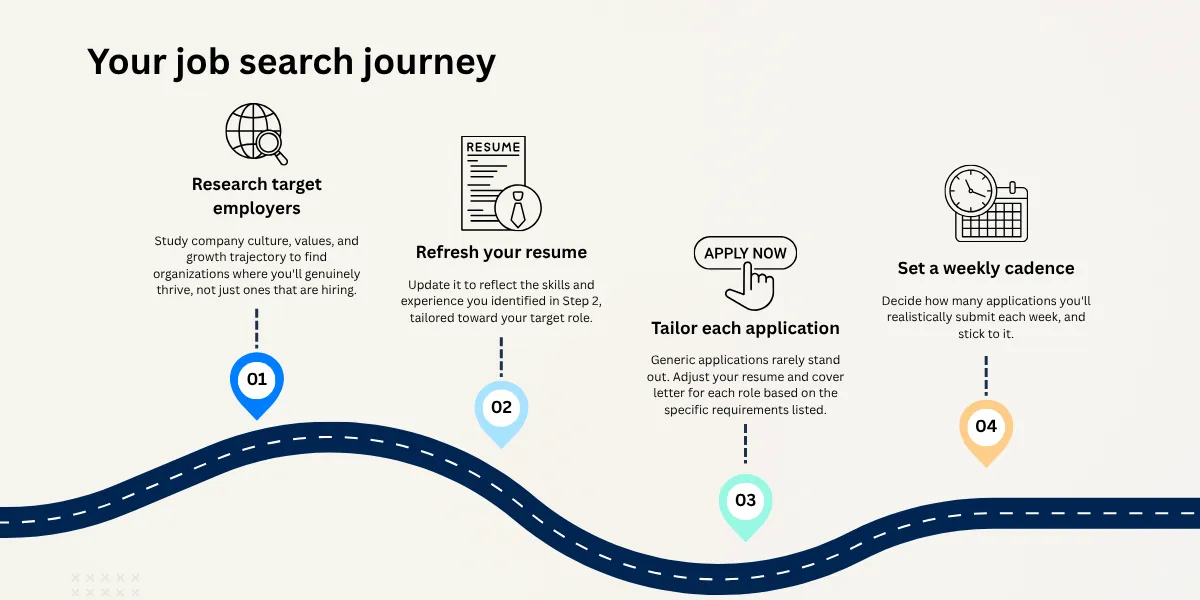
Here's where realism matters most: three strong, tailored applications a week beats twenty rushed ones. Building job search planning around a sustainable rhythm keeps you consistent over months, which is ultimately what gets results.
Quick tip: Referrals and online job boards remain two of the most effective channels for finding roles, especially in customer experience and support fields. Don't overlook your existing network when you're ready to apply.
For region-specific openings and guidance on navigating applications, check out TTEC's blog on job applications and localized opportunities (link). And once your plan is in motion, explore current openings at TTEC (link) to put your action plan into practice.
Step 4: Track your progress with the free checklist
Everything covered so far, your goals, your skills assessment, and your action plan, comes together in one tool: a free, downloadable, printable 2027 Career Goals Checklist. Think of it as the companion piece to this entire guide.
The checklist includes sections for:
- Defining your career goals
- Assessing your skills
- Preparing your resume
- Researching target employers
- Tracking applications
- Measuring progress over time
This isn't a one-and-done worksheet. It's built as a living document you can revisit monthly, updating it as you complete certifications, submit applications, or move closer to your 2027 goal. Having everything in one place makes it far easier to stay consistent, especially during the months when job searching feels slow.
Make 2027 the Year You Took the Lead
Four steps stand between where you are now and where you want to be: define your goals, assess your skills, build your action plan, and track your progress. None of them require a dramatic leap. They require consistency, and a plan you'll actually follow.
This is a journey you're equipped to start today, not someday. Download your free 2027 Career Goals Checklist to put this framework into practice, and when you're ready to take the first concrete step, explore current openings at TTEC to see where your next move could take you.
Frequently Asked Question
How do I set career goals for 2027?
Use the SMART framework: make your goal specific, measurable, achievable, relevant, and time-bound. Instead of a vague ambition like "get a better job," define the exact role, timeline, and measurable outcome you're working toward.
How do I know what skills I need to grow my career?
Start with a self-assessment. List your current technical and soft skills, then compare them against the requirements of your target role. Any gaps you identify point directly to where training, mentorship, or certification can help.
How do I start a job search plan?
Break it into four steps: research target employers, refresh your resume, tailor each application to the role, and set a sustainable weekly application cadence. Three strong applications a week is more effective than a high volume of generic ones.
Where can I find a free professional development checklist?
The free 2027 Career Goals Checklist is available for download directly within this guide. It covers goal-setting, skills assessment, resume preparation, employer research, and progress tracking in one printable document.
Join us and thrive
Your next opportunity starts here. Whether you're actively searching or simply exploring what’s next. our Talent Community connects you with opportunities that align with your goals.