
Business Development Representative vs. Customer Service: Which Career Fits You?

6 Minute Read
10/15/2026
Key Takeaways
- BDRs create new business opportunities, while customer service professionals help existing customers and resolve their needs.
- Both careers rely on communication, listening, and relationship building. BDRs lean on prospecting and persistence, while customer service leans on empathy and problem-solving.
- Experience in one role can lead to the other, so choose based on the work you enjoy most and read the job description before you apply.
If you like working with people and solving problems, both business development representative (BDR) and customer service roles are worth a look. They can seem similar from the outside, but the day-to-day work is quite different. So when it comes to BDR vs customer service, which one fits you? Let’s break it down.
Business development representative vs. customer service: what’s the difference?
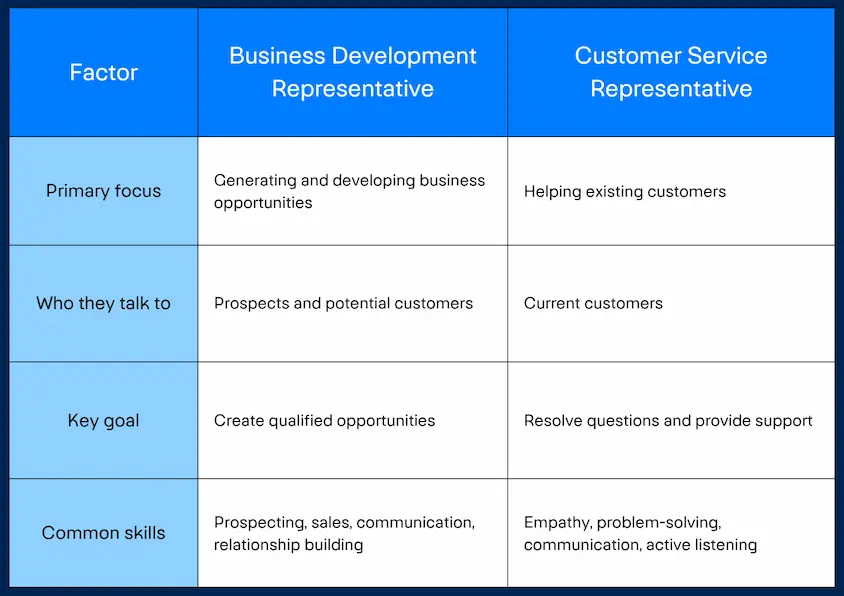
Responsibilities vary by employer, industry, and product, and some roles mix sales and customer service. But the clearest way to think about it is this: BDRs help create future business, while customer service professionals help existing customers get the most out of their relationship with a company.
What does a business development representative do?
A business development representative or BDR usually works near the start of the sales process. Instead of waiting for a customer to ask for help, they find potential customers and start the conversation themselves.
A typical day might include:
- researching prospects
- reaching out by phone or email
- asking questions about a prospect’s needs
- qualifying potential opportunities
- scheduling conversations with the sales team
- following up and keeping records in a CRM system
Beyond making sales calls, a good BDR listens closely and figures out whether there’s a real business need the company can address. Persistence matters, too, because not every conversation turns into an opportunity.
What does a customer service representative do?
Customer service professionals help people who already use a company’s products or services. Their work can include:
- answering questions
- troubleshooting problems
- processing requests
- explaining products or services
- resolving complaints
- escalating issues to another team when needed
The goal is always to help the customer reach the right solution and leave with a good experience. That takes patience and empathy, especially when someone is frustrated.
Comparing customer conversations
The biggest difference between a business development representative and customer service shows up in the conversation itself.
A BDR starts the conversation to discover an opportunity. They might ask about a prospect’s business, learn about a challenge, and guide the prospect toward the next step in the sales process.
A customer service representative responds to an existing need, like a question, a technical problem, or a billing concern.
Both depend on listening, though. A BDR who talks too much can miss key details about a prospect, and a customer service professional who doesn’t listen closely can misread the problem.
BDR vs. CSR: What skills do you need?
The skills overlap more than you might expect. Communication, active listening, relationship building, adaptability, and comfort with digital tools help in either role. The emphasis is what changes:
- BDRs lean on prospecting, persuasion, research, goal-oriented work, and persistence.
- Customer service professionals lean on empathy, patience, troubleshooting, attention to detail, and product knowledge.
You don’t need every skill on day one. Training and experience can build a lot of them.
Is a BDR job basically customer service?
No. A BDR is primarily a sales and business development role, while customer service supports existing customers.
They can feel alike because both involve talking with customers and building relationships. The purpose is different. A BDR is working out whether a potential customer is a real business opportunity, and a customer service professional is helping an existing customer solve a problem. Neither is more valuable. They just support different parts of the customer journey.
Which career is more sales-focused?
If sales is what draws you in, business development is usually the closer match. BDRs spend much of their time identifying prospects, qualifying opportunities, and moving them toward the next stage. Depending on the employer, performance may be measured by activities, qualified opportunities, or pipeline.
Some customer service roles include sales-related work, like upselling, cross-selling, or supporting retention, but not all of them do. Look at the actual responsibilities in a job posting instead of relying on the title alone.
Finding a career that fits your work style
If you like meeting new people, starting conversations, researching businesses, and working toward measurable goals, a BDR role could suit you.
If you’d rather help people who already use a product, answer questions, and find solutions, customer service may feel more natural.
There is plenty of overlap. Your experience, interests, and willingness to learn matter more than fitting a certain personality type.
Can you switch between the two careers?
Yes, in both directions.
Customer service to BDR: your experience understanding customer needs, explaining products, handling concerns, and using CRM systems all helps when talking with prospects. The skills you may need to build are sales-specific ones like prospecting, lead qualification, and pipeline management. Training, mentorship, or a sales-related role can help you get there.
BDR to customer service: BDRs build experience in communication, managing relationships, and explaining value. Those skills can carry over to customer service, customer success, and account management.
A background in one field won’t automatically qualify you for every role in the other, but it gives you transferable experience to build on.
Exploring career paths for BDR and CX roles
Neither career has one fixed path. A BDR might move into an account executive or sales representative role, then explore account management, sales leadership, or sales operations. A customer service professional might become a team lead, then move into operations, training, quality assurance, or customer experience leadership.
You can also move between these areas. The communication and problem-solving skills you gain in one role can help you qualify for another.
Business development and customer service careers at TTEC
TTEC offers customer experience opportunities across customer service, sales, and business development, depending on location and current hiring needs.
If you’re considering a role, start with the current job description. Check the responsibilities, qualifications, language requirements, location, work arrangement, and schedule. That’ll help you see whether a role matches your current skills or helps you build the ones you want next.
Find the customer experience career that fits you
A BDR career and a customer service career can both help you build valuable communication and relationship-building skills. The difference is how you use them.
If finding new opportunities gets you fired up, explore business development. If you enjoy solving problems and helping existing customers, customer service may be the better fit.
Not sure yet? That’s okay. Explore both paths, compare current opportunities at TTEC, and find the role that matches where you want your career to go.
Frequently Asked Questions
What is the difference between a BDR and customer service?
A BDR focuses on generating and qualifying new business opportunities. A customer service representative focuses on helping existing customers and resolving their needs.
Is a BDR a customer service job?
Generally, no. A BDR is primarily a sales and business development role, though it uses many of the same customer-facing skills.
Can customer service experience help you become a BDR?
Yes. Customer service builds transferable skills like communication, problem-solving, and understanding customer needs. You may also need to add sales skills, such as prospecting and lead qualification.
Which career is better: BDR or customer service?
Neither is better across the board. The right choice depends on your interests, strengths, and goals. Ask yourself whether you’re more excited about developing new business or helping existing customers.
Can a BDR transition into customer success or customer service?
Yes. BDR experience builds skills in communication, relationship management, and CRM use that can support a move into customer success, customer service, or account management.
Join us and thrive
Your next opportunity starts here. Whether you're actively searching or simply exploring what’s next. our Talent Community connects you with opportunities that align with your goals.